Happy Halloween! On this day in 1955, the New York Times ran this story: 'Wife Kills Woodward, Owner of Nashua; Says She Shot Thinking He Was a Prowler; Widow Taken to Hospital After Tragedy in Dark Oyster Bay Home'.
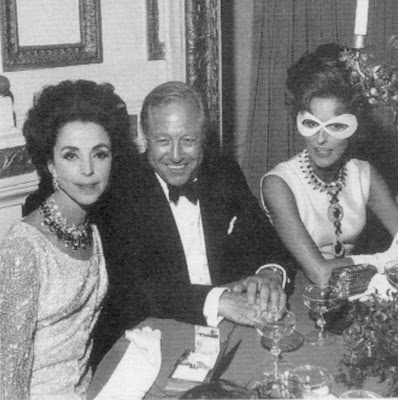
On the evening of October 29, 1955, Ann Woodward and her husband, William (always called Billy) attended a dinner party given in honor of the Duchess of Windsor. Ann brought up the subject of the prowler terrorizing the North Shore of Long Island who had broken into the Playhouse (the Woodward home in Oyster Bay) and made it clear she intended to go to bed armed. Later, at least one fellow guest confessed that they felt as though the scene for what eventually happened was being set.
What eventually happened was that shortly after 2:00 A.M. on October 30, Ann emptied both barrels of a custom-made English rifle into her husband. One wound was a so-called flesh wound - destroying one side of his handsome face - while the other was fatal, a piece of birdshot entering his brain and killing him within ten minutes. Ann might have been a notoriously incompetent shot, even injuring elephants on a recent big game shoot in India, but a target ten feet away would have been difficult to miss.
From the moment police arrived, Ann insisted that she had mistaken Billy for the prowler, odd, considering he was not only in close range, but naked, having just emerged from the shower or bed. As a wit commented at the time: "Just how many prowlers do their rounds in the nude?'
Nearly as suspicious were the different versions of events recalled. Did she aim at a shadow, thinking it was the prowler, a man believed to be armed? Or simply shoot blindly into the darkened hall? Luckily for her, Elsie Woodward told the police she was as sorry for Ann as for her late son. Publicly, at least, she wholeheartedly supported the daughter-in-law, who, while safely hidden away at the Doctors' Hospital on the Upper East Side of Manhattan, asked where her jewelry was, but never asked to see her young sons (perhaps as a result of the trauma, both would commit suicide as adults). Privately, Elsie was said to have believed Ann guilty of first-degree murder. It was no secret that the marriage was stormy, and had been for years. Recently, Billy had fallen in love with a second cousin. Circumstances prevented him from marrying Princess Marina Torlonia (grandmother of Brooke Shields) in 1949 - his best friend, Grenville Baker, mysteriously died from a bullet wound to the head on the Florida plantation owned by his family - but this time, Billy may have been determined to get a divorce. Ann had made him miserable for years with her jealousy, ironic, as she had indiscretions of her own (most notably with Prince Aly Khan, then newly-engaged to Rita Hayworth). She staged one public scene after another, each prompted by Billy's interest (or perceived interest) in other women. There was an exception, though; "Why don't you bring a man into our bed?" she once shouted, much to the amazement of onlookers. "That's what you want, anyway!" While the validity of the statement is questionable, it was one of the most damaging things she could have said at a time when homosexuality was, incredibly, considered a mental illness.
But the grand jury never heard about the temper tantrums, nor repeated fits of violence. What they heard was that the prowler (who was swiftly apprehended) had been on the Woodward property that morning, after all, despite a local paper having claimed he was miles away from the Playhouse at the time of the shooting. His presence not only explained, but justified the tragic event. Ann appeared suitably distraught, and three weeks after the shooting, the grand jury deliberated for just thirty minutes before unanimously voting not to indict.
From then on, she made herself scarce in New York, spending most of her time in Europe. But she would never live down her reputation; while in Venice, a noblewoman publicly reproached her husband for chatting to Ann, making it clear that while it was quite all right to flirt, could not refrain from asking: "must you flirt with a murderess?" The most notorious incident along those lines - thanks to the late Dominick Dunne, who based The Two Mrs. Grenvilles on the case - involved Truman Capote. Ann drunkenly made an anti-gay slur in a Biarritz bar and paid for it the following evening when Truman cocked his thumb, pointed his finger directly at her and shouted in his famously falsetto voice: "Bang, bang! Bang, bang!" Rumor had it that she left before breakfast the following morning.
There were other rumors over the years. Ann drank and was notoriously promiscuous, even asked to leave the Villa Taylor in Marrakech after being caught luring local boys over the wall. But there was a persistent, highly pernicious rumor of a very different nature making the rounds; an enraged Ann shot Billy after being confronted with evidence of bigamy. To date, no proof of an earlier marriage has emerged, but Truman - admittedly prone to telling stories "as they ought to be told" - incorporated the rumor within a chapter from his never-to-be-finished novel Answered Prayers, 'La Cote Basque 1965', named for the eponymous restaurant across from the St. Regis Hotel. Casting himself as a Proustian narrator, Truman's literary alter-ego recounts a boozy lunch spent observing the other patrons. Ann was so thinly disguised that Truman did not bother to change her first name. A friend in publishing recognized her at once and quickly rang in warning; 'La Cote Basque 1965' was due to run in the November 1975 issue of Esquire. Ann caught the next flight to New York. Heavily sedated and in the care of a nurse, she went straight to her Fifth Avenue duplex, where an advance copy of the magazine had been sent. Within days, she overdosed on Seconal. Coincidentally, Truman's mother had killed herself in precisely the same manner and as a result, Truman had long had a horror of suicide, but whether he felt guilty about Ann or not is debatable. If so, that in combination with becoming an overnight pariah - few who read 'La Cote Basque 1965' remained his friend - would have made life extraordinarily difficult. But he put on a brave face, asserting a year later that "all literature is gossip" - twisting what John F. Kennedy once said about history to suit his own purposes - while becoming increasingly dependent on alcohol and drugs, both contributing to his premature death in 1984.
Elsie Woodward, once a close friend, followed suit; according to her, it was the suggestion of bigamy that had sent Ann over the edge. Even so, one wonders how sorry she truly was. Elsie had always detested Ann, confessing during a rare weak moment: "One look and I knew the whole story". Now she was gone. If, in common with many others, Elsie regarded the suicide as a form of delayed justice, no one would have blamed her. She seemed eager to place the episode in the past, commenting: "Well, that's that. She shot my son and Truman just murdered her and so now I suppose we don't have to worry about that anymore."


No comments:
Post a Comment